

To deliver a world-class, high-performance cloud service in Japan, GMO Internet launched “GMO GPU Cloud” in November 2024. The service leverages NVIDIA H200 Tensor Core GPUs, NVIDIA Spectrum-X™ Ethernet networking, and DDN’s ultra-high-speed storage, EXAScaler.
With a 96-node multi-node configuration achieving 38.06 PFLOPS, the system ranked 37th globally and 6th in Japan on the TOP500, a global benchmark for supercomputer performance, and achieved the top performance among commercial cloud providers*1.
We spoke with the team about the “GMO GPU Cloud,” one of Japan’s fastest AI infrastructure services, and the DDN storage powering it.
The Optimal Choice Based on NVIDIA Reference Architecture: “DDN EXAScaler”

Executive Lead, Project Management Team
System Division, GMO Internet, Inc.
GMO Internet decided to enter the GPU cloud business at the end of 2023. Yoshiaki Sato, Executive Lead, Project Management Team, System Division, GMO Internet, Inc. explained: “This initiative was driven by the Ministry of Economy, Trade and Industry’s public call for cloud programs. In Japan as well, there was a need for AI infrastructure environments with near-supercomputer-level performance that meet global standards, requiring extremely high-speed infrastructure, including storage.”
In April 2024, GMO Internet received certification from the Ministry of Economy, Trade and Industry (METI) for its Supply Assurance Plan for ‘Cloud Programs,’ which are designated as Specified Critical Materials under the Economic Security Promotion Act*2. The company also announced a capital investment of 10 billion yen and the launch of services by the end of 2024.
Sato reflected on the selection process, emphasizing that storage was as critical as compute performance in a high-performance GPU cluster: “NVIDIA’s reference architecture defines the required I/O performance. We looked for storage that met those requirements while offering excellent cost performance. We compared multiple products, but at the time, only DDN delivered superior performance, competitive pricing, and NVIDIA certification.”

Virtualization Technology Team
Software and Virtualization Technology Department, System Division
GMO Internet, Inc.
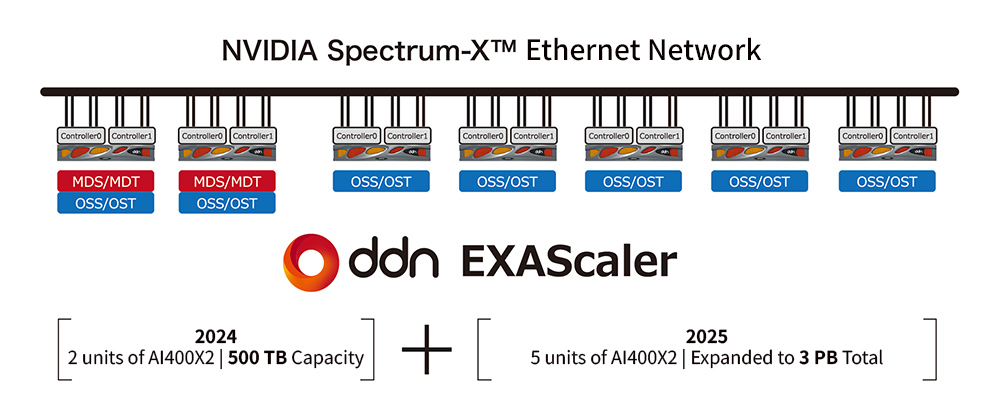
As a result, GMO GPU Cloud adopted DDN EXAScaler (AI400X2) with a 500 TB configuration. Masafumi Okawa, Virtualization Technology Team, Software and Virtualization Technology Department, System Division commented: “Our goal with GMO GPU Cloud is world-class performance, so matching storage I/O performance is essential. The 170 GB/s read and 140 GB/s write speeds from DDN were unlike anything we had seen before—it was truly impressive.”
Taito Hasegawa, who leads the storage team in the same department, added: “With other storage systems, we sometimes see performance degradation, but with DDN, we have not seen that at all.”
As demand for GMO GPU Cloud grew and more customers adopted the service, signs of capacity shortage began to appear by mid-2025 due to increased usage. In response, the DDN storage was expanded to a 3 PB configuration. The expansion demonstrated linear performance scaling, achieving 219 GB/s read and 194 GB/s write speeds in production environments.
Okawa, who frequently uses the system, also praised its write performance: “Even checkpoint writes during AI training complete in times comparable to locally installed high-speed storage. Despite being a shared distributed file system, it never becomes a bottleneck. We’ve had no issues.”
Customer Demand: “We Want DDN Even for Bare Metal”
In December 2025, GMO Internet launched a new service featuring NVIDIA HGX B300 for inference workloads as part of its GMO GPU Cloud (bare metal configuration). This expansion responds to demand for the latest GPUs and inference capabilities. “Customers asked for ‘the latest GPUs’ and ‘inference support.’ We decided to start with a bare metal offering that leverages GPUs optimized for AI inference, enabling high-speed large language model inference,” said Sato.
However, bare metal configurations require different tenant isolation compared to existing GPU clusters, and inference workloads impose different storage requirements such as data types and retention periods. Initially, the adoption of DDN storage was reconsidered—but strong customer demand changed that direction.

Leader, Virtualization and Shared Technology Team
Infrastructure Technology Department, System Division
GMO Internet, Inc.
“We received multiple requests from customers saying, ‘We want DDN even for bare metal,’” said Hasegawa. The reason lies in performance differences. “DDN’s speed is on another level,” he added, while Okawa noted, “Even tens of GB/s are fast, but DDN delivers over 200 GB/s. That difference is significant.”
Reflecting these customer voices, GMO Internet is considering including DDN in the storage lineup for its bare metal services. Depending on user requirements, DDN EXAScaler will be used for high-performance needs, network file storage for flexible tenant isolation, and object storage for data portability and long-term retention. To support DDN in bare metal environments, network isolation using LNET (Lustre Networking) has been implemented. Separate LNET configurations for existing services and bare metal environments enable multi-tenant support. The company plans to validate usability through feedback from lead users.
“To use GPUs efficiently, it’s critical that storage does not become a bottleneck. High write performance significantly reduces data ingestion lead time,” said Okawa.
High Praise for DDN’s Technology and Support, with Expectations for Continued Innovation
The next phase for GMO GPU Cloud includes virtualization and container-native adoption. “We are considering integration with Kubernetes. To simplify subsystem management through container orchestration, CSI driver support is required,” said Hasegawa.
Okawa is also evaluating options considering Lustre’s characteristics: “Lustre can become complex in cloud-native environments. While we want to move toward CSI support, whether to continue with the current configuration requires further consideration.” This brings attention to Infinia, DDN’s newly released AI-focused data platform. “A more cloud-native model has emerged. Rather than just wanting to test it, we believe it is essential,” said Sato.
As GMO Internet continues its innovation journey, Okawa emphasized the importance of DDN storage: “Beyond product quality, vendors that help their customers grow are rare. DDN truly empowers users, including how to use the technology effectively.”
Hasegawa also highly values DDN’s support system: “Our storage team includes many junior members, but thanks to DDN’s support, we can assign them tasks with confidence. The ability to receive quick, one-on-one responses gives us a strong sense of trust.”
Finally, Sato shared his trust and expectations for DDN: “Overall, the system is very stable. Even when issues arise, they are resolved without impacting customers, and we highly value DDN’s technical capabilities. As we handle customer data, ensuring safety is critical. We look forward to continuing to evolve our GPU cloud services together with DDN.”

About GMO Internet, Inc.
A comprehensive IT company with the vision of “Internet for Everyone.” The company launched its high-performance cloud service “GMO GPU Cloud H200” in November 2024 and expanded it in December 2025 with the addition of the B300 (bare metal configuration) service.

DDN Solution
- Use Case
Storage for high-performance cloud service “GMO GPU Cloud” - Deployed System

DDN AI400X2
*This case study is based on an interview conducted with GMO Internet, Inc. on January 14, 2026.
*1 As of November 2024: https://group.gmo/en/news/article/835/
*2 https://group.gmo/news/article/8933/ (Japanese page)
公開日時